
Proposed Research: Do incomplete Varroa treatments amplify acaricide resistance through survivor bottlenecks?
- Posted
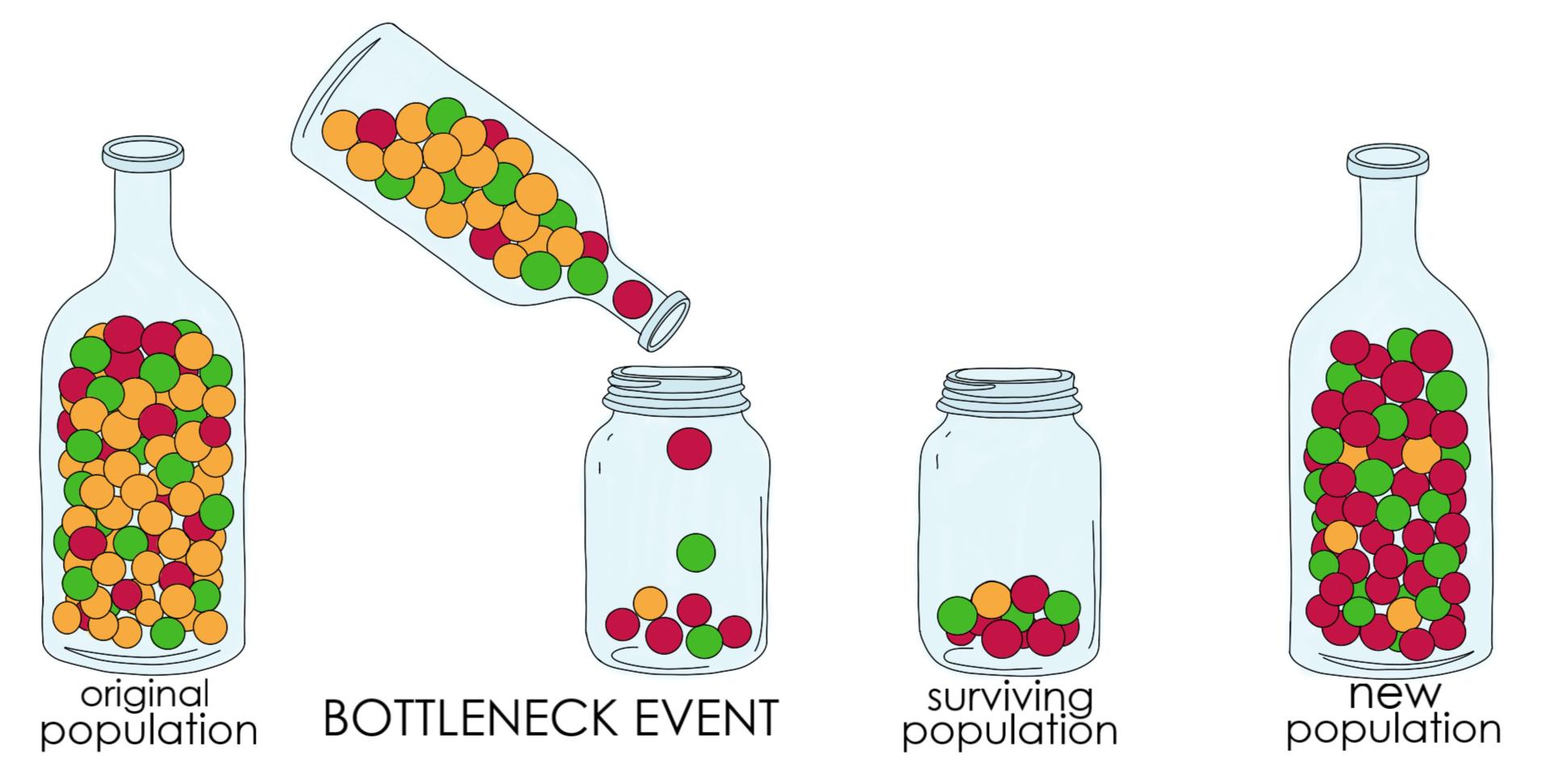
My proposed concern and reason for a call for additionally research is that its possible that treatments may impose a strong filter or “population bottleneck” through which mites surviving an otherwise effective treatment might reproduce becoming a larger portion of the total future population and carry resistance in larger numbers into the next generation. Each unsuccessful treatment cycle could continue to expand on this effect accelerating treatment resistance faster than otherwise would be modeled. Meanwhile, new evidence on diploid clonal sons suggests that small-family reproduction may preserve maternal alleles rather than loss them which is different from earlier haplodiploid model predictions.
Primary question: Does a treatment that leaves few mites increase the frequency of phenotypic resistance among the mites that reproduce in later generations, and does the magnitude of the effect depend on how strongly the survivor population is reduced?
Secondary questions:
- Does treatment reduce genome-wide diversity or heterozygosity in the surviving mite population?
- Are changes in resistance frequency explained mainly by differential survival (selection), by random loss of variation (drift), or by both?
- Do resistant survivors reproduce as successfully as susceptible survivors?
- Does the observed diploid-male reproductive system alter resistance inheritance, inbreeding, or diversity loss after a bottleneck?
- How much do brood refuge and mite movement between colonies contribute to apparent treatment failure or resistance rebound?
The study would provide a direct test of a currently under-investigated link: whether treatment-generated survivor bottlenecks change the trajectory of resistance in Varroa, and whether the mite’s reproductive biology modifies that trajectory. It could also clarify whether apparent treatment failure is mostly due to resistant survivors, brood refuge, reinvasion, or a combination. The practical value would be better evidence for monitoring treatment efficacy and designing resistance-management programs.
In brief: the proposal’s most novel contribution is not simply asking whether survivors can be resistant, but experimentally separating resistance selection from the genetic consequences of a small survivor population—and testing both against Varroa’s newly reported reproductive system.
Proposed Study
This study would test whether an acaricide treatment that leaves a small surviving population of Varroa destructor causes resistance to increase faster than would be expected from treatment selection alone—and whether the mite’s reproductive genetics alter that outcome.
The central distinction is between selection and a bottleneck. If a treatment kills susceptible mites more readily than resistant ones, it can increase the resistant fraction among survivors. A small survivor population can also lose genetic diversity by chance. But a bottleneck does not automatically promote resistance: it could eliminate resistance variants, preserve them, or increase their frequency, depending on which mites survive and reproduce. The proposed study therefore measures both resistance and genetic diversity across generations.
A recently published study changes an important premise for the project. Varroa was long assumed to be haplodiploid; a 2026 pedigree study instead reports diploid sons that are genetic clones of their mothers, with males transmitting either maternal allele to daughters. Its model predicts slower heterozygosity loss under bottlenecks than under ancestral haplodiploidy. The authors do not test acaricide treatment or resistance evolution, so applying that result to treatment survivors remains a hypothesis.
Background and rationale
Acaricide resistance in Varroa is established, and resistance-management strategies are not fully resolved. Lester’s 2023 review states that “there is little published evidence that pesticide rotation is beneficial” and notes studies where resistance persisted despite rotation. The review also highlights the mite’s breeding system as a potential complication for conventional resistance-management models.
Resistance can have identifiable genetic associations, but those associations may be complex or population-specific. For example, a 2021 study associated amitraz resistance with mutations in the mite’s β-adrenergic-like octopamine receptor. A 2024 French study, however, found that a previously proposed receptor variant did not by itself explain resistance in the populations examined. That argues for measuring both phenotype—actual susceptibility—and genotype, rather than treating a single marker as a universal indicator.
The proposed concern is that treatment may impose a strong filter: mites surviving an otherwise effective treatment may be more resistant, may carry resistance-linked variants, or may simply be a non-random subset for other reasons, such as location in capped brood. If survivors reproduce, those differences may carry into the next generation. Meanwhile, the new evidence on diploid clonal sons suggests that small-family reproduction may preserve maternal alleles differently than earlier haplodiploid models predicted. The interaction between these processes has not been directly established.
Treatment efficacy also varies with conditions inside the colony. Many mites are in capped brood, where some treatments may not reach them effectively; treatment timing, brood status, and reinvasion can therefore mimic or obscure resistance. A colony with mites remaining after treatment is not, by itself, evidence that the mites are genetically resistant.
Research questions and hypotheses
Primary question: Does a treatment that leaves few mites increase the frequency of phenotypic resistance among the mites that reproduce in later generations, and does the magnitude of the effect depend on how strongly the survivor population is reduced?
Secondary questions:
- Does treatment reduce genome-wide diversity or heterozygosity in the surviving mite population?
- Are changes in resistance frequency explained mainly by differential survival (selection), by random loss of variation (drift), or by both?
- Do resistant survivors reproduce as successfully as susceptible survivors?
- Does the observed diploid-male reproductive system alter resistance inheritance, inbreeding, or diversity loss after a bottleneck?
- How much do brood refuge and mite movement between colonies contribute to apparent treatment failure or resistance rebound?
Hypotheses
- H1—Selection: If resistance varies among mites before treatment, survivors will show greater resistance in standardized bioassays than the pre-treatment
- H2—Bottleneck effect: Smaller survivor populations will show greater random changes in allele frequencies and reduced genetic diversity than larger survivor The direction of change in any particular resistance variant will not necessarily be upward.
- H3—Resistance persistence: If resistance has little reproductive cost, resistance will persist or increase during subsequent reproduction, especially where there is continued treatment exposure or limited immigration of susceptible
- H4—Reproductive-system effect: Diploid clonal sons may preserve maternal alleles and reduce loss of heterozygosity relative to predictions from haplodiploid Whether that preservation affects resistance evolution is an empirical question, not an assumption.
Study design
Phase 1: Establish baseline populations
Collect mites from multiple, geographically separated apiaries with documented treatment histories. For each source population:
- Measure susceptibility to the selected acaricide using a validated laboratory
- Genotype mites using genome-wide markers and known or candidate resistance markers relevant to the
- Record colony treatment history, treatment timing, brood status, and mite infestation
- Where feasible, establish replicate mite lines from each source population under controlled
Using several source populations is important because resistance mechanisms and allele frequencies may differ between locations. A marker associated with resistance in one population may not explain resistance in another.
Phase 2: Controlled treatment and survivor bottlenecks
Within each source population, randomly assign replicate experimental units to:
- Untreated control: No acaricide
- Label-compliant treatment: A registered treatment applied according to its approved
- Naturally incomplete efficacy condition: A treatment scenario resulting in a range of survivor numbers, studied only under appropriate regulatory and animal-welfare
The experiment should not expose field colonies to deliberately inadequate or off-label treatment. Incomplete efficacy can instead be studied in contained laboratory or semi-field systems, or by sampling colonies after approved treatments where efficacy varies naturally. A preliminary pilot should determine safe and repeatable exposure conditions; the main experiment should compare outcomes rather than assume a specific level of mortality.
A key design feature is to separate selection from bottleneck size. Where feasible, create comparisons with similar survivor population sizes but different survivor composition, and comparisons with similar treatment exposure but different survivor counts. This helps distinguish “resistant mites survived disproportionately” from “a small random sample happened to shift in frequency.”
Phase 3: Follow reproduction over generations
Transfer surviving foundress mites into standardized brood-cell conditions and follow their offspring through multiple reproductive generations. Include enough replicate lines to estimate variation among lines, rather than relying on a single survivor group.
At each generation, measure:
- mite survival and reproductive output;
- daughter production and successful reproduction;
- susceptibility to the relevant acaricide;
- resistance-marker and genome-wide allele frequencies;
- heterozygosity and other diversity measures;
- male and female ploidy and parent–offspring inheritance, in a subset of
Pedigree and genomic sampling should be designed around the 2026 finding that Varroa males may be diploid clones of their mothers and can transmit either maternal allele to daughters. The study should verify the reproductive pattern in its own populations rather than assume it is identical everywhere.
Phase 4: Validate in colonies
If contained experiments identify a clear effect, test whether it occurs in managed colonies under normal, approved treatment practice. Sample mites before treatment, immediately after treatment, and during follow-up. Record brood status, treatment compliance, reinvasion indicators, and mite levels. A rise in mite numbers after treatment could reflect survivors reproducing, mites entering from other colonies, or mites emerging from brood; those explanations must be distinguished where possible.
Outcomes and analysis
The primary outcome would be the change in measured acaricide susceptibility from pre-treatment mites to survivors and their descendants.
Key secondary outcomes would include:
- change in frequency of validated resistance-associated variants;
- genome-wide diversity and heterozygosity before and after treatment;
- resistance and reproductive success across descendant generations;
- the relationship between survivor-group size and subsequent genetic change;
- evidence of mite immigration or
Use a hierarchical model with source population and experimental replicate as grouping factors. Treatment, survivor number, baseline susceptibility, and generation should be modeled separately, including their interactions. Track resistance markers alongside bioassay results; a marker-frequency change without a corresponding change in susceptibility should not be interpreted as demonstrated functional resistance.
The crucial comparison is whether the treatment-associated shift in resistance is larger than the shift in untreated controls, and whether that shift changes with bottleneck size. Genetic diversity loss alone would demonstrate a bottleneck effect, not resistance selection. A rise in resistance alone would demonstrate selection, not that the bottleneck itself caused or amplified it.
Why diploid males matter—and what should not be assumed
The 2026 study reports that Varroa males are diploid clones of their mothers and that the male can transmit either copy of her genome to daughters. It also models a higher inbreeding effective population size and slower heterozygosity loss under bottlenecks than in haplodiploid systems.
This does not mean that a bottleneck is harmless, that resistance is preserved, or that resistant mites can reproduce without meaningful genetic consequences. The study concerns inheritance and modeled diversity loss, not acaricide resistance or treatment survivors. The proposed research should test whether the reproductive mechanism changes resistance inheritance and diversity after treatment; it should not treat the predicted preservation of alleles as proof that resistance will propagate.
Limitations and safeguards
- Treatment failure is not synonymous with resistance. Poor timing, capped brood, application errors, environmental conditions, or reinvasion can leave mites in a Measure and record these factors.
- Resistance may be polygenic or population-specific. Combine bioassays with broader genomic data instead of relying on one candidate
- A bottleneck can reduce, increase, or leave resistance frequency unchanged. The outcome depends on the survivors and subsequent
- Colony-level trials must avoid creating avoidable harm. Do not withhold effective control or intentionally use off-label doses in production colonies; use contained experiments for controlled exposure and approved treatments for field
- Reinvasion can mask within-colony evolution. Sample nearby colonies or use other appropriate methods to assess immigration, and interpret field results Lester’s review identifies population maintenance and reinvasion as processes that need to be disentangled in resistance research.
Expected contribution
The study would provide a direct test of a currently under-investigated link: whether treatment-generated survivor bottlenecks change the trajectory of resistance in Varroa, and whether the mite’s reproductive biology modifies that trajectory. It could also clarify whether apparent treatment failure is mostly due to resistant survivors, brood refuge, reinvasion, or a combination. The practical value would be better evidence for monitoring treatment efficacy and designing resistance-management programs—not a justification for deliberately incomplete treatment.
Selected research to include
- Lester, P. J. (2023). “Integrated resistance management for acaricide use on Varroa destructor.” Frontiers in Bee Science, 1, Review of resistance-management evidence and the difficulties of applying conventional strategies to Varroa.
- Eliash, N. et al. (2026). “Varroa mites escape the evolutionary trap of ” Nature Communications, 17, Article 10392. Three-generation pedigree study and modeling of Varroa inheritance and bottleneck-related heterozygosity.
- Hernández-Rodríguez, C. S. et al. (2022). “Resistance to amitraz in the parasitic honey bee mite Varroa destructor is associated with mutations in the β-adrenergic-like octopamine ” Journal of Pest Science, 95, 1179–1195. A resistance-mechanism study; useful for selecting candidate markers, with the caveat that marker relevance may vary among populations.
- Marsky, U. et al. (2024). “Amitraz Resistance in French Varroa Mite Populations—More Complex Than a Single-Nucleotide ” Insects, 15, 390. Relevant evidence that a single proposed variant may not explain resistance across populations.
- Dynes, T. L. et al. (2017). “Fine scale population genetic structure of Varroa destructor, an ectoparasitic mite of the honey bee (Apis mellifera).” Apidologie, 48, 93–101. Background for population structure, gene flow, and the need to sample at appropriate scales
- Roth, M. A. et al. (2020). “Biology and Management of Varroa destructor (Mesostigmata: Varroidae) in Apis mellifera (Hymenoptera: Apidae) Colonies.” Journal of Integrated Pest Management. Background on mite biology, treatment, and brood-related limitations.