
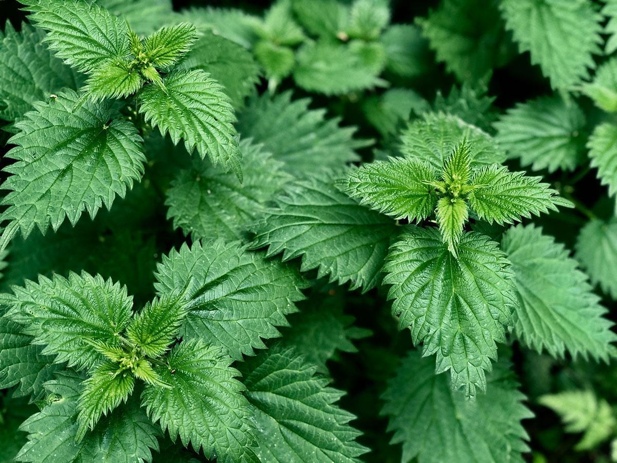
Stinging nettle for Varroa control: evidence and concerns
- Posted
DISCLAIMER: The blog below is generally created from the research listed in the “Referenced Materials” section. This is not my research. All credit is given to these studies and researchers who are helping beekeepers better understand how we can improve our management practices.
Introduction
Stinging nettle (Urtica dioica) has been tested as a possible botanical treatment for Varroa destructor, a parasitic mite that harms honey bees (Apis mellifera). The main evidence is a 2025 field study by Sakla and colleagues. It found substantial reductions in measured mite infestation after nettle-extract and nettle-smoke treatments. But the study was small and short, and its findings have not yet been independently corroborated well enough to establish nettle as a dependable or safe treatment.
“Natural” does not automatically mean safe, effective, or free of residues. Nettle contains biologically active substances, and applying a plant preparation inside a hive can expose bees, brood, and hive products to a variable mixture. If used, it should be considered experimental at this time.
What the study tested
The researchers treated 12 naturally infested colonies in one apiary during autumn 2023. Colonies were divided among four groups—nettle extract, nettle smoke, formic acid, and untreated control—with three colonies in each group. The trial lasted three weeks. The comparison treatment was 65% formic acid.
The study used two nettle application methods:
- Ethanolic extract spray: A 20% weight/volume nettle extract was prepared using 70% ethanol, concentrated, diluted with water, and sprayed onto the combs. Each hive received 20 millilitres per comb across seven frames—140 millilitres per hive—weekly for three weeks.
- Dried nettle smoke: Researchers burned 10 grams of dried nettle in a smoker and directed the smoke into the hive. They covered the hive immediately to retain smoke and repeated treatment every three days.
They measured mite infestation on adult worker bees and in sampled sealed worker brood, as well as fallen mites, dead bees, and selected biochemical indicators in workers and pupae. They also used gas chromatography–mass spectrometry (GC–MS) to identify compounds in the nettle extract. GC–MS is a laboratory method for separating and identifying chemical constituents; it helps describe what was in the tested extract, but does not establish which constituents caused mite mortality, whether they are safe for bees, or whether they remain in honey.
Reported mite-control results
At the end of three weeks, the paper reported the following reductions in measured infestation:
| Treatment | Mites measured on adult bees | Mites measured in sealed brood |
| Nettle extract | 88.93% | 86.73% |
| Nettle smoke | 76.28% | 94.82% |
| Formic acid | 100% | 100% |
In this trial, extract had the larger reported reduction on adult bees, while smoke had the larger reported reduction in sealed brood. Formic acid had the largest reported reduction in both measures. These are the study’s reported results, not established expectations for other apiaries or conditions.
The small number of colonies—three per treatment—and short follow-up make it difficult to know how reproducible these percentages are. Measuring infestation in worker-bee and brood samples also does not by itself establish long-term whole-colony control, winter survival, or protection against reinfestation.
What the study says about bee health
The authors report lower observed worker mortality with nettle treatments than with formic acid, no observed dead larvae, stable colony strength during the trial, and no apparent short-term negative effect on queen productivity. They also measured malondialdehyde (MDA) and glutathione-S-transferase (GST). MDA is used as an indicator associated with oxidative damage; GST is an enzyme involved in detoxification. These measures can reveal biological responses to treatment, but they are not a complete test of bee health or proof that a treatment is harmless.
The findings are encouraging as preliminary observations, but they do not establish long-term safety:
- Queen and egg-laying: The study reports no apparent short-term effect on queen productivity. It does not establish effects on laying rate over a full season, queen longevity, supersedure, mating, or outcomes after repeated treatments.
- Workers: The mortality and biochemical measures provide limited short-term information. They do not rule out effects on behavior, nursing, feeding, flight, lifespan, immune function, or winter survival.
- Brood and pupae: The authors report no dead larvae during the trial and measured biochemical indicators in pupae. The study does not establish that every developmental stage is unaffected, or rule out subtle or delayed effects on development, emergence, or adult performance.
- Colony performance: Stable strength over a short period does not show that honey production, population growth, or overwintering success are unaffected.
A lower MDA reading or changed GST activity should not be interpreted as proof that nettle protects bees from harm. These are indicators, not comprehensive outcomes.
Does nettle reach mites in capped brood?
Varroa mites cycle between a phoretic phase—when female mites are carried on adult bees—and a reproductive phase inside capped brood cells.
The study measured infestation both on adult bees and in sampled sealed brood. So, its reported results are not limited to mites counted on adult bees. But the study does not prove that nettle chemicals penetrated capped cells and directly killed mites inside them. Reduced infestation in sampled brood could also reflect fewer mites entering cells or broader changes in the mite population. The study did not directly track the fate of mites and their offspring inside individual capped cells or establish the mechanism.
For comparison, formic acid is known to be capable of reaching mites in capped brood under suitable conditions. Whether nettle extract or smoke can reliably do so remains unresolved.
Possible risks and practical concerns
The extract’s chemical profile and the smoke produced by burning dried nettle may vary with the plant material and preparation. The study identified compounds in one extract, but did not establish a standardized product, a reproducible dose for routine use, or the safety profile of each compound in the hive.
Reasonable concerns for further study include:
- Effects on bees at higher or repeated doses: A substance that harms mites could also affect bees under different exposure conditions.
- Variation in preparation: Plant source, growing conditions, harvest time, drying, extraction, and burning can change the mixture and dose.
- Exposure of brood and nurse bees: Spraying combs or retaining smoke in the hive exposes more than just mites on adult bees.
- Smoke and ventilation: The study’s method of covering the hive to retain smoke is experimental; it does not establish safe limits for routine field use.
- Colony outcomes: The study did not establish efficacy across climates, seasons, hive types, or long treatment periods, nor whether nettle prevents colony losses.
- Resistance claims: A single study does not show that nettle offers a proven resistance-management advantage.
These are plausible uncertainties, not proof that nettle causes harm. The study’s limited size and duration mean that it could miss uncommon or delayed effects.
Honey and human consumers
The study did not test honey, wax, pollen, propolis, or other hive products for nettle-derived residues. It therefore cannot show whether residues occur, how long they persist, or whether treatment changes honey’s flavor or quality. Because the extract was sprayed directly onto combs and bees, contact with stored honey is possible; smoke may also deposit material on hive surfaces or products. But residue levels and human health effects were not measured.
In the United States, the Environmental Protection Agency (EPA) says that it has not evaluated unregistered pest-control products for potential harm to people or the environment. It also notes that residues from unregistered products could create legal concerns for honey and other hive-derived foods. This does not show that nettle-treated honey is contaminated; it means residue safety has not been established, and local rules matter.
Research limitations
The evidence is preliminary because:
- It comes from one field study in one apiary, location, and season.
- There were only three colonies per treatment, limiting confidence and the ability to detect uncommon effects.
- The trial was short, with no evidence on long-term queen performance, brood development, overwintering, or sustained mite control.
- Results do not establish a standardized preparation or dose that beekeepers could reproduce reliably.
- The study did not determine precisely how nettle affects mites in capped brood or what also is happening to the pupa.
- Honey and hive-product residues, as well as human exposure, were not assessed.
- The reported bee-health measures cover only a small portion of possible behavioral, developmental, reproductive, and colony-level outcomes.
- Independent replication is limited, so there is not yet strong corroborating evidence.
Conclusion
The 2025 study provides promising preliminary evidence that nettle extract and nettle smoke can reduce measured Varroa infestation. It also reports lower observed bee mortality than the formic-acid comparison and no obvious short-term harm to queen productivity or larvae. But the small trial, lack of substantial independent confirmation, uncertain action in capped brood, limited bee-safety observations, and absence of honey-residue testing leave major questions unanswered.
For now, nettle should be regarded as an experimental candidate rather than a validated replacement for established treatments. Beekeepers should monitor mite levels and use treatments approved for their location according to label directions; integrated management guidance emphasizes monitoring before and after treatment.